Supported protocols
For all supported field protocols, device communication can be examined through the Device watch and Debugger tools in the Client.
MODBUS
MODBUS is a master-slave communication protocol. Telecontrol SCADA supports MODBUS over RS-485, RS-422, RS-232, and Ethernet TCP/IP, covering MODBUS RTU, ASCII, and TCP deployments.
The Server exchanges telemetry and control values through standard MODBUS function codes and maps them to SCADA objects.
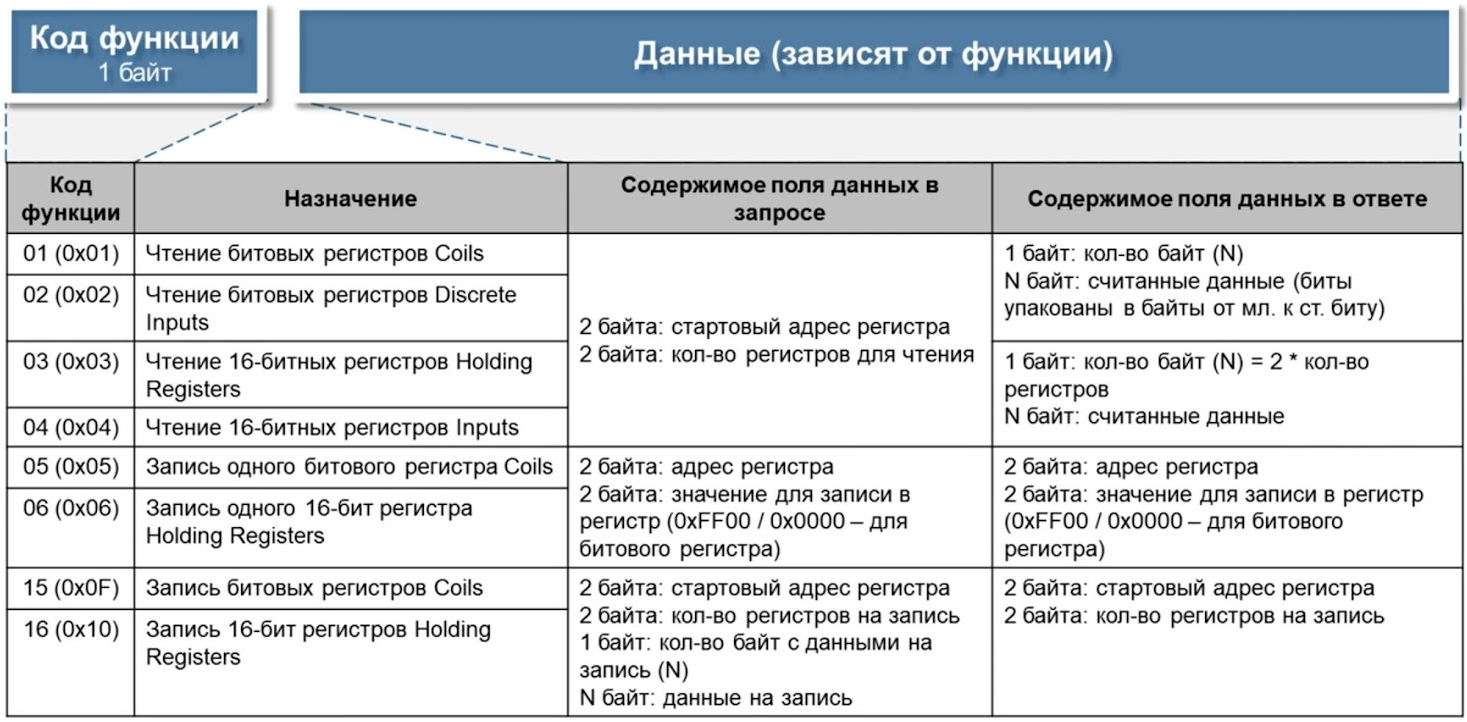
See also the engineering reference for MODBUS devices.
IEC 60870-5
IEC 60870-5 directions define data channels such as a network endpoint or serial port. One direction can serve multiple devices.
Supported application-layer ASDU types include:
| ASDU label | Type ID | Description |
|---|---|---|
M_SP_NA_1 |
1 | Single-point information |
M_SP_TA_1 |
2 | Single-point with timestamp |
M_DP_NA_1 |
3 | Double-point information |
M_BO_NA_1 |
7 | 32-bit bitstring |
M_ME_NA_1 |
9 | Normalized measured value |
M_ME_NB_1 |
11 | Scaled measured value |
M_ME_TB_1 |
12 | Scaled measured value with timestamp |
M_ME_NC_1 |
13 | Short floating-point measured value |
M_IT_NA_1 |
15 | Integrated total |
M_SP_TB_1 |
30 | Single-point with CP56Time2a |
M_DP_TB_1 |
31 | Double-point with CP56Time2a |
M_ME_TD_1 |
34 | Normalized value with CP56Time2a |
M_ME_TE_1 |
35 | Scaled value with CP56Time2a |
M_ME_TF_1 |
36 | Float value with CP56Time2a |
M_IT_TB_1 |
37 | Integrated total with CP56Time2a |
C_SC_NA_1 |
45 | Single command |
M_EI_NA_1 |
70 | End of initialization |
C_IC_NA_1 |
100 | General interrogation |
C_CI_NA_1 |
101 | Counter interrogation |
C_CS_NA_1 |
103 | Time synchronization |
C_RP_NA_1 |
105 | Reset process |
P_ME_NA_1 |
110 | Parameter write, normalized |
P_ME_NB_1 |
111 | Parameter write, scaled |
P_ME_NC_1 |
112 | Parameter write, float |
For control operations, Telecontrol SCADA uses:
C_SC_NA_1for discrete control objectsP_ME_NC_1for measured-value control objects
The ASDU type can be overridden in the output field with the format
type:address, where type is one of:
BOOLto useC_SC_NA_1INT16to useP_ME_NB_1FLOATto useP_ME_NC_1
This override is useful when a measured object must be controlled with
C_SC_NA_1 instead of the default measured-value command ASDU.
When UDP server mode is used, multiple remote devices can share one direction. Devices are identified by the remote IP address and port, so separate listening ports are not required for each one. UDP mode also supports devices that send datagrams built from multiple IEC messages.
See also the engineering reference for IEC 60870-5 devices.
IEC 61850
IEC 61850 support provides transparent access to the device information model. Data acquisition is performed through subscriptions to RCB/BRCB report blocks transported over MMS.
Before data collection can begin, the required report blocks must exist on the IEC 61850 device. After a connection is established, the Server configures those report blocks for spontaneous event transmission.
Object binding uses MMS addresses in the format:
LogicalDevice/LogicalNode$FC$DataObject
Typical functional constraints are:
FC=STfor discrete-state bindingsFC=MXfor measured-value bindingsFC=COfor control commands
Two-stage control commands are supported.
Only UTC timestamps are supported. If the device uses a different time zone, timestamp handling may become problematic.
The operator can also initiate a full interrogation of the device.
Translation status
This English page is now a functional protocol reference. The Russian page still contains fuller wording and a few extra implementation notes.